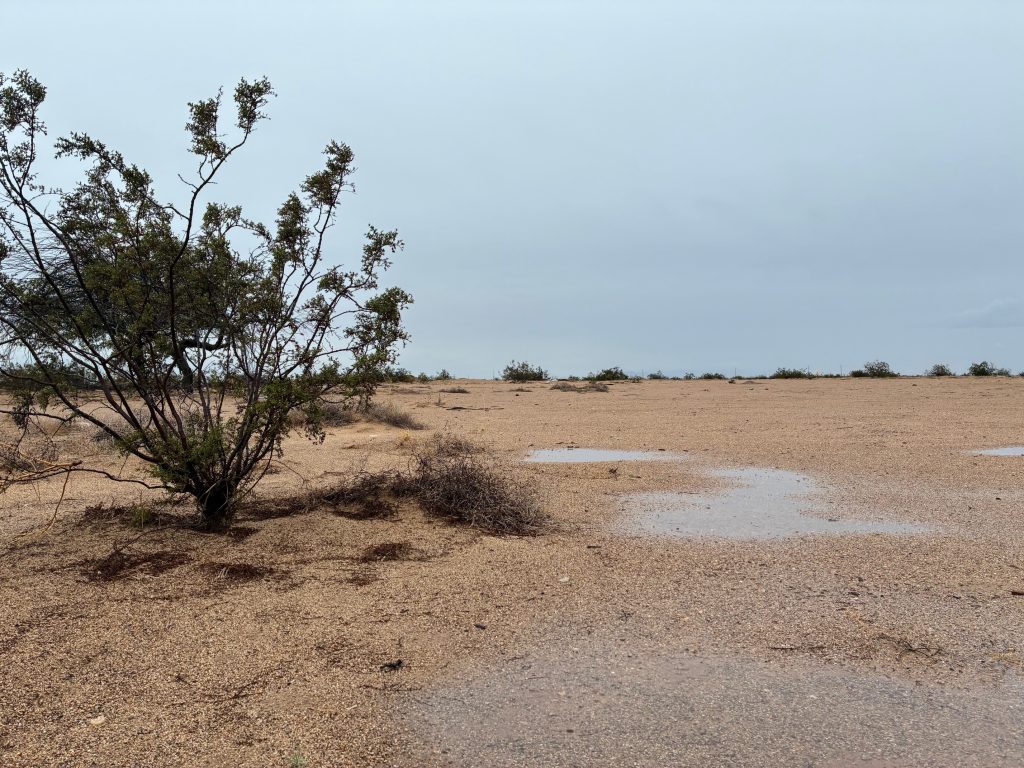
I grew up in Yuma Arizona, a town in the Sonoran Desert near the border of Mexico. About two and a half hours east of San Diego and receiving less than four inches of rain a year, the town is in a rain shadow. A rain shadow is a geographic and atmospheric phenomenon at an area on the leeward side of a mountain. The mountains force moist air coming from the ocean to rise, cool, and release precipitation before the moisture can make its way to the other side of the range. This creates a stark difference in landscape and climate where San Diego and its Jacumba mountains are cooler, wetter, and greener, and east of the mountains heading towards Yuma is hot, dry, and sandy with desert plants.
People living in a rain shadow have a different relationship with rain. I have memories of looking out the window seeing dark clouds forming in the sky and going outside to see if it was sprinkling yet, only to look around the neighborhood and see my neighbors outside also in the anticipation position- hands palm face up, eyes scanning the sky above them, checking if any action was happening yet, making sure they didn’t miss it. If you ask anyone that grew up in the desert what their favorite weather is, at least 8 out of 10 will mention something about clouds or rain. And the other two maybe shouldn’t be trusted.
Yuma specifically is the sunniest city in North America. Most days are almost completely clear, not a cloud in the sky. So even the presence of some clouds passing overhead provides something different to look at. We typically have two “rainy seasons,” in the late summer and in the winter. By “rainy seasons” I mean, days with a chance of rain, as some years, rain barely comes at all. Sometimes there’s only teasing clouds that get blown away to a more fortunate land. The monsoon season of late summer happens when intense heating of the landmass of southwestern US and northwest Mexico causes a wind shift over the Gulf of California, bringing warm, moist air from the sea over to us. I didn’t know or understand the workings behind the weather and climate as a kid in the desert. I just knew that I loved the rain.
I know that in part, my love for rain made me want to live somewhere else eventually. I ended up going to college in North Carolina, and this was my first prolonged exposure to rainier weather. I bought a pair of pink rain boots, excited to need such a thing. I found that Carolina rains were much different than desert rains, as it could be raining all day for multiple days and there was plenty for an actual umbrella. I could understand why people living in rainy places saw it as a nuisance, having to do daily life while avoiding getting soaked. Although I understood the perspective, I still enjoyed the rain. One of my more memorable times was a summer I spent at Duke retaking a chemistry class. For one week that summer, it rained every afternoon. The busses weren’t running their full schedules like they did during the regular semester, so my roommate and I ran home after class and labs were done for the day, hugging our backpacks to our chests to protect our notes and doing our best to coordinate running in sync while huddling under our one functioning umbrella (hers). I remember arriving at our apartment soaked (an indication of our less-than-synced running) but I wasn’t bothered. Actually running home in the rain felt exhilarating for some reason. Maybe it was still the desert kid in me that felt it was something special. Maybe I would feel different if I stayed there long enough. But four years later and I wasn’t jaded. I still loved the rain by graduation, and loved North Carolina so much that I hoped I would move there one day.
It’s been almost ten years since that rainy Carolina summer. After graduation, I lived the next two and a half years in Alaska, another interesting weather place with a fair amount of snow and rain (for a desert girl) and of course, the Northern lights. With the twists and turns of life, and having spent the majority of my life with one thing I thought was certain (I would not live in the rain shadow again), I now find myself completing my sixth consecutive adult year in Yuma, living in the rain shadow.
I would like to say that my years of life and experiences have made me a grateful person, that I have grown enough in wisdom that I understand and perfectly appreciate the environment I grew up in. But I can’t say that exactly. There are many mornings I squint my eyes as I open the door to walk outside to my car, annoyed at the sun shining too brightly. Driving to work, there’s too many days without a single cloud in the sky. Nothing but a bright shining blue that doesn’t scream “bliss” to me but instead “this is not where you wanted to be.”
I think loving the rain growing up, and wanting to live somewhere it rained frequently was not just about the weather. It was also about dreaming of a life filled with more of what I loved, about having things I found to be good fill more of my days and not feel as seldom. It was about building a life where I didn’t feel like I was waiting so long for some good times to happen. It was about goodness, joy, love, and peace being the norm and not just a lucky day in a monsoon season.
Like I find myself bothered by the weather in this rain shadow I’ve returned to, I also find myself deeply affected by a life I thought would be different. The heartbreaks and griefs of life have left wounds in my heart that don’t heal in the way the world promises. I find it hard to dream or plan anymore. I struggle with depression and hopelessness. I have a quiet sadness within me that has lasted years. Despite what the well-meaning well-wishers say about the sad days being just a season, I understand that there are some pains that create a climate of grief that never really goes away.
I appreciate the parts of my life that seem more possible to dream. At work, we are planning restoration projects where hundreds of acres along the Colorado River (and where the river is now dry but used to flow) will be restored with native plants that once thrived there. A big part of these projects is bringing water back to the land. Last spring, I taught my first ever college course as an adjunct professor. Teaching environmental science for non-science majors, we had one class focused on the Sonoran Desert. In this class, I had the students go outside and write for half an hour on prompts I provided. Most of the prompts were designed to think about rain, the sounds, smells, and feelings we have when it rains in the desert. I learned something special in preparation for this class that I was the most excited to share with my students. It’s about the smell of rain and desert plants. One of the common phrases you hear when the clouds start to build up here is “it smells like it’s going to rain.” There’s a book by Gary Nabhan called “The Desert Smells Like Rain.” It talks about desert plants, and specifically the creosote bush.
The town of Yuma is wrapped up in a blanket of creosote. You cannot drive in any direction without passing open deserts filled with them. From far away they don’t look like much, and create the speckled desert most interstate eyes gloss over. But up close, the plant has small dark green leaves that bloom tiny yellow flowers. The creosote bush (larrea tridentata) is extremely drought tolerant and can live without water for up to two years. It’s considered the most drought tolerant plant in North America, having an extensive root system that is highly efficient in finding water. In particularly long, dry seasons with severe drought, it will drop its leaves to conserve energy and allow itself to wait longer for rain. When the rain comes, it recovers rapidly, sprouting new green leaves within days. It is the Sonoran desert example of waiting for rain, and perhaps no other species here has evolved to wait quite as well.
Back to the smell of rain, Gary Nabhan and professors at the University of Arizona have done research on desert plants to discover that the creosote and other desert plants are able to detect the onset of rain, and in anticipation they release smells (volatile organic compounds) that produce the unique smell of desert rain we experience here. What we are sensing is the joy of nature receiving what it had been waiting for.
It’s been a fun last few months in the rain shadow. After almost a whole year without any rain, the rain came in late summer, and again in early fall. It was the 9th wettest August in Yuma, which came from one monsoon storm on August 25th that produced 1.12 inches of rain, five times the normal amount of precipitation for that month. Then it was the wettest meteorological fall (September-November) on record with 4.06 inches of rain. We were gifted with Christmas Eve rains, and as I write this, what looks to be New Years Eve rains as well.
The latest drought report for Arizona sets us back to reality; despite it being a rainy fall, “Odds continue to favor warmer and drier than normal conditions this winter.” (Arizona Short-Term Drought Status Report November 2025). We’re still in the desert. We’re still in the rain shadow.
I believe that places can teach us and I’ve been reflecting on what my desert home can teach me. I think we are naturally inclined to desire abundance. Who wouldn’t want the good things all the time? But there is goodness to be found in spiritual deserts, in long seasons of waiting and hoping, and even in hurting. As a believer, I know that we are called to do what sounds strange to the world, which is to glory in our sufferings, because we know that “suffering produces perseverance; perseverance produces character; and character produces hope. And hope does not put us to shame” (Romans 5:3-5). Through faith, we wait because we know that God always provides. A lot may come at once, or a little here and there, but it is always enough. We can live in the rain shadow no matter how long the drought is because we know what’s coming.
“Ask rain from the Lord in the season of the spring rain, from the Lord who makes the storm clouds, and He will give them showers of rain, to everyone the vegetation in the field.” Zechariah 10:1
As a fellow desert rat, rain shadow Yuma native I feel this too & am forever drawn to & taken by weather with the possibility of moisture.
Beautifully written. Thank you for the share that reduces the miles between us this New Years Eve 2025. Love you.
This is so beautiful, Jenny! I have fond memories of you & your Mom standing outside in the rain in Fairbanks . . . Your appreciation giving me a new perspective! I’ve lived in mountains, valleys , river communities, and deserts – you have really captured a piece of God’s creation in an eternal light!! 🎉